
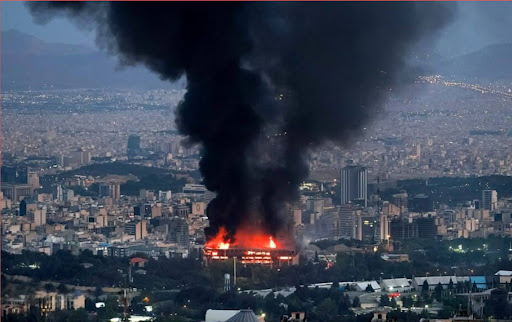
The international community watched in near-paralysis on Saturday as the United States and Iran continued exchanging devastating blows across the Gulf, with no major power able or willing to step in as a mediator. Iran launched ballistic missiles at the UAE, striking near Fujairah’s major oil port, while US warplanes bombed Kharg Island for the second day. Iranian rockets also struck Israel, and Israeli warplanes conducted dozens of raids inside Iran. The war, now in its third week since February 28, was growing broader and more destructive with each passing day.
President Trump posted on social media calling on China, France, Japan, South Korea, and the UK to dispatch warships to the Strait of Hormuz, which Iran had closed since the start of hostilities. The appeal was notable for what it implicitly admitted — that the US did not have a unilateral plan to reopen the waterway. Trump also said he was not ready to negotiate with Iran, calling the current terms unacceptable. He warned that Iran’s remaining oil infrastructure could be targeted if Tehran did not allow ships to pass through the strait.
Iran’s response was to keep escalating. Its military threatened to attack any Gulf energy or economic facility with American ties and called on Arab states to expel US forces. Iranian commanders warned civilians near UAE ports and US installations to evacuate. At least 15 people were killed in Isfahan when an Israeli strike hit a factory. Iran’s strategy, analysts said, was to inflict maximum economic and political pain on US allies while keeping the regime intact and waiting for a better negotiating moment.
The economic stakes were enormous. The Strait of Hormuz carries about one-fifth of global daily oil and gas, and its closure had driven prices toward $120 per barrel. Analysts warned that oil could reach $150 if Kharg Island’s export capacity was fully destroyed and the Fujairah disruptions persisted. Gulf energy infrastructure that took decades to build was now being targeted in a conflict with no clear end. Trump had so far held back from fully destroying Iran’s oil facilities, but his public threats suggested that restraint was conditional and fragile.
The human toll of the war was accumulating at an alarming pace. More than 1,400 Iranians had been killed under sustained bombing. Thirteen Israelis and roughly 20 Gulf residents had also died. Lebanon’s crisis continued, with 800 killed and 850,000 displaced from Israeli strikes on Hezbollah. Six US troops died in a military aircraft crash in western Iraq. The US embassy in Baghdad was struck by missiles, and all Americans in Iraq were ordered to leave immediately. With Trump refusing to set an end date and Iran refusing to back down, the world faced the real prospect of a prolonged and catastrophic regional war.